

‘A.H.E.A.D’, stands for Applied Health Education and Development.
AHEAD summarizes our methodology – the holistic development of a community in four phases:
1. HEALTH EDUCATION is the Entry Point into communities
2. APPLYING this knowledge by PRACTICALLY improving water sanitation AND hygiene (WASH) in the second year.
3. DEVELOPMENT: WASH evolves into to a ‘Livelihoods’ programme – ‘Food Agriculture and Nutrition’ (FAN) to ensure food security and growth and development of children
4. SOCIAL CAPITAL: community management of wider social development issues, such as substance abuse, child rights, domestic abuse and human rights.
Rationale for the CHC Model
The CHC Model works because it provides a structure within which the whole group can endorse decisions, thus removing any individual fears or risks of ‘going it alone’.
This strategy is different from the ‘trickle down approach’ whereby a few ‘enlightened’ individuals slowly influence others to adapt.
Community Health Clubs provide a forum for discussion leading to group consensus and the whole group rises up together.
When a critical mass of people within the health club decide to do something, the rest will follow even if they do not appreciate all the reasons.
The CHC Model of Development is:
- STRUCTURED: A known membership within a Community Health Club: a committed group formed specifically to promote health rather than a loose gathering of people addressed ad hoc.
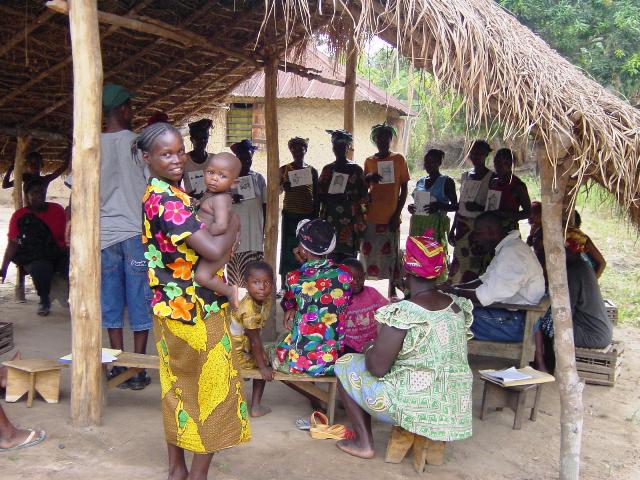
- MEASURABLE: Topics, key messages and targets are set in a syllabus summarised in a membership card.
- REGULAR: Club holds weekly health sessions for at least six months which reinforce good practices.
- GROUP CONSENSUS: the training focuses on the group as a whole rather than targeting individuals.
- INCLUSIVE : knowledge can be shared infinitely, rather than providing handouts which cause division as people complete for scarce resources.
- PARTICIPATORY: Activities are all fun and interactive – discussion is provoked by ranking a range of illustrated cards that depict local issues. Song, slogans, poetry and drama are produced by the club to illustrate solutions and encourage compliance by the group.
- HOLISTIC: Topics addresses a myriad of diseases (malaria, bilharzia, skin disease, worms, measles, trachoma, guinea worm, HV/AIDs, ebola, cholera, environmental enteropathy) rather than a mono focus on diarrhoea.
- HORIZONTAL: We address all causes of ill health, including gender, disability, vulnerability, age and poverty.
- LONG TERM: The initial training takes only six months but we remain engaged with CHCs and if fund permit can take them through a four year process of development so they are fully functional community able to manage their own health and livelihoods.
Sabine
I see You’re in point of fact a good webmaster.
The web site loading velocity is incredible. It sort of feels that you are doing any distinctive trick.
Also, the contents are masterpiece. you have performed a magnificent job in this subject!
Similar here: sklep online and also here:
Sklep internetowy